




When we think of antibodies, sharks and alpacas probably aren't the first animals that come to mind. However, both possess unusual antibodies that are helping scientists explore new possibilities in medicine.
Unlike IgG antibodies, which have a familiar Y-shaped structure, VNARs and VHHs are tiny, single-domain antibody fragments capable of recognizing specific molecular targets. Their small size, stability, and versatile structures make them promising tools for drug discovery, diagnostics, and biotechnology.
Conventional IgG antibodies are large proteins that help the immune system recognize foreign substances. They typically weigh around 150 kilodaltons (kDa) and contain four protein chains: two heavy chains and two light chains.
Sharks and camelids, such as alpacas and llamas, produce special types of antibodies that function without light chains. Scientists can isolate their individual antigen-binding domains to create much smaller proteins called single-domain antibodies (sdAbs).
These domains are roughly one-tenth the size of a conventional antibody, allowing researchers to explore therapeutic applications where smaller binding proteins may be beneficial.
Two important examples are:
VHH (Variable Heavy-Chain Domain): Derived from camelid heavy-chain-only antibodies and commonly called a nanobody.
VNAR (Variable New Antigen Receptor): Derived from IgNAR antibodies found in sharks and other cartilaginous fish.
While both have similar antigen-binding functions, their evolutionary origins and molecular structures are different.
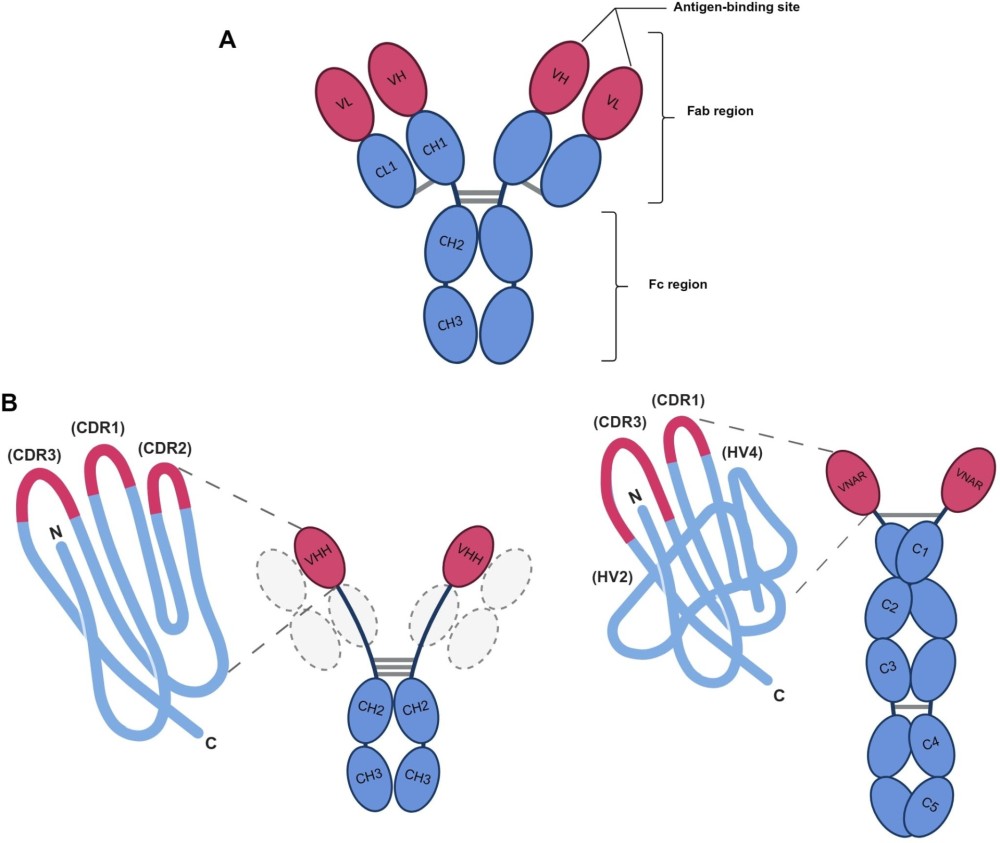
Feature | VNAR | VHH |
Origin | Sharks and other cartilaginous fish | Camelids (llamas, alpacas, camels) |
Molecular weight | Approximately 12–15 kDa | Approximately 12–15 kDa |
Antigen-binding regions | CDR1, CDR3, HV2, and HV4 | CDR1, CDR2, and CDR3 |
Structural characteristics | Distinctive antibody fold with variable disulfide bond patterns and often elongated CDR3 loops | Antibody-like fold with three CDR loops, sometimes including an extended CDR3 |
Access to hidden epitopes | Can recognize recessed or difficult-to-access epitopes | Can also recognize recessed or difficult-to-access epitopes |
Clinical development | Primarily investigational | Established, with approved therapeutics |
Therapeutic potential | Alternative binding architecture for challenging targets | Established platform for antibody engineering and therapeutic development |
VNARs evolved in the immune systems of sharks, whose ancestors developed adaptive immunity hundreds of millions of years ago. Their unusual structure contains two conventional complementarity-determining regions, CDR1 and CDR3, alongside additional hypervariable regions.
The CDR3 loop can be particularly long and flexible, allowing some VNARs to reach hidden or recessed areas on proteins that may be difficult for conventional antibodies to access. VNARs can also exhibit resistance to challenging conditions, including changes in temperature and acidity. However, stability varies between individual molecules.
These properties make VNARs interesting candidates for applications such as:
Cancer immunotherapy
Targeted drug delivery
Diagnostic testing
Transport of therapeutics across biological barriers
For example, researchers have investigated VNAR-based approaches to targeting PD-L1 in cancer and transporting therapeutic molecules across the blood-brain barrier. While promising, most VNAR-based therapeutic technologies remain in preclinical or early clinical development.
VHHs were discovered in camelid heavy-chain-only antibodies in the early 1990s. Since then, they have become widely used in biomedical research.
Like VNARs, VHHs are small and can recognize difficult-to-access protein regions. Their structures contain three conventional CDRs, similar to the variable domains of traditional antibodies. One major advantage of VHHs is their established track record in therapeutic development.
For example, caplacizumab (Cablivi), a VHH-based therapy, was approved to treat acquired thrombotic thrombocytopenic purpura, a rare blood disorder.
VHH technology has also contributed to treatments for cancer and inflammatory diseases, including applications in engineered immune-cell therapies. Beyond therapeutics, researchers use VHHs in imaging, diagnostic assays, and protein research. Their relatively simple structures can also make them suitable for recombinant protein production and engineering into multifunctional antibody formats.
Learn about VHH antibody discovery.
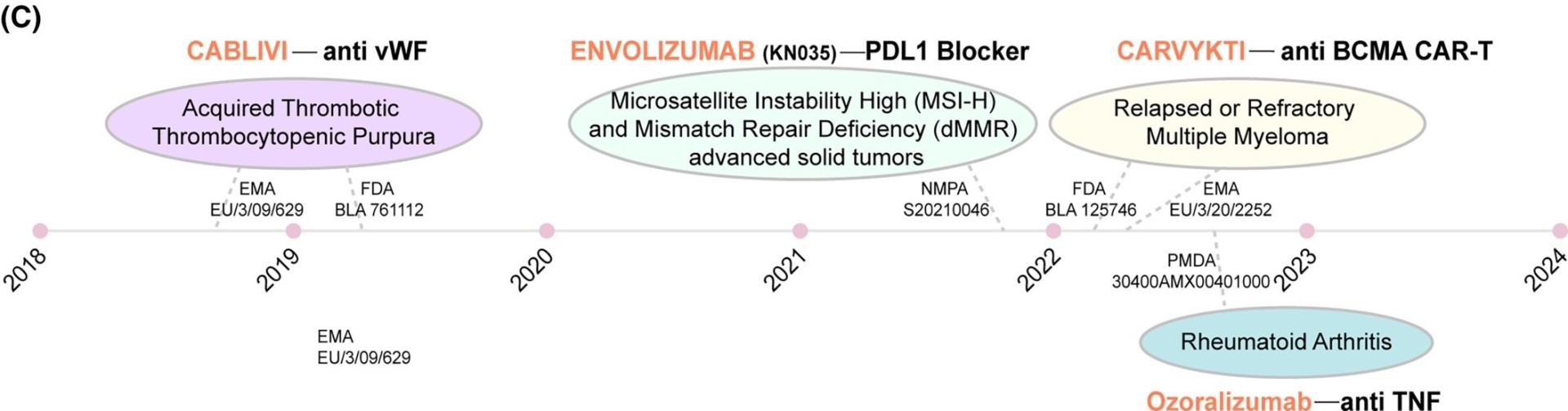
As antibody engineering advances, both VNARs and VHHs are expanding the possibilities for next-generation biologics. Their small structures make them attractive building blocks for multispecific therapeutics, targeted delivery systems, and other engineered proteins.
High-throughput expression, binding characterization, and developability testing can help researchers identify promising candidates and optimize their properties. Ultimately, VNARs and VHHs demonstrate how two very different evolutionary pathways have produced valuable tools for modern biotechnology.
Biointron's Q3 2026 Antibody Industry Trends report aims to explore the events a……
Biointron’s Q2 2026 Antibody Industry Trends report aims to explore the events a……
Biointron’s Q1 2026 Antibody Industry Trends report aims to explore the events a……
Biointron’s Q2 2025 antibody industry report aims to explore the events and tren……