


Antibody discovery is driven by diverse methodologies, from throughput-driven sequence identification to integrated, quality-aware lead generation. Technologies such as antibody library display, single B-cell sequencing, and next-generation sequencing have enabled increasingly efficient identification of antigen-binding sequences. However, translating these candidates into molecules suitable for downstream development remains a multi-step process influenced by expression efficiency, stability, and manufacturability.
Several recent studies suggest a growing emphasis on combining microfluidic screening platforms, high-throughput (HT) discovery and expression strategies, and early-stage developability assessment within discovery workflows. Rather than focusing solely on binding affinity or sequence enrichment, these approaches aim to incorporate additional layers of functional and biophysical evaluation earlier in the process.
Microfluidic technologies have been explored as a means to address the disconnect between genotype identification and functional phenotype characterization. As summarized in a recent review, microfluidic systems based on valves, microwells, and droplets enable controlled manipulation of antibody-secreting cells within miniaturized environments.
Droplet-based systems, in particular, support:
Encapsulation of single B cells or antibody-producing variants
Retention of secreted antibodies within picoliter-scale compartments
Coupled measurement of secretion and binding or cell-based activity
Sorting based on functional outputs rather than surrogate binding signals
These formats allow screening strategies in which functional activity (e.g., receptor engagement or cell-based responses) can be evaluated directly. In some implementations, co-encapsulation of target cells enables context-dependent functional assays within the same microenvironment.
At the same time, it is important to note that microfluidic platforms can involve complex device design, and are still primarily used in controlled laboratory settings.

High-throughput antibody discovery platforms have expanded through the integration of library display technologies, single-cell sequencing, and automated screening systems. As described in a recent article, these approaches support rapid identification of antibody variable region sequences from large and diverse repertoires.
Key capabilities include:
Construction and screening of large combinatorial antibody libraries
Integration of next-generation sequencing (NGS) for clone identification
Use of FACS and microfluidics for enrichment of high-affinity or specific binders
Automated and array-based screening formats to increase parallelization
Sequence identification is followed by expression and downstream characterization, forming a multi-step pipeline from library to candidate molecule. However, several steps remain comparatively resource-intensive:
Gene synthesis and cloning of selected sequences
Expression and purification of candidate antibodies
Functional and biophysical validation
Now, these stages require only two weeks of effort, when large numbers of candidates are advanced in parallel with automation.

Developability considerations are increasingly discussed in the context of early discovery, particularly as a means to reduce downstream risk. Zhang et al. (2023) define developability in terms of the likelihood that an antibody can be manufactured, formulated, and advanced through development with acceptable properties.
Key developability attributes include:
Homogeneity (e.g., absence of aggregation or heterogeneity)
Stability (thermal and chemical)
Solubility (including high-concentration behavior)
Specificity (including nonspecific interactions)
These properties are influenced by antibody structure and are reflected in measurable outputs such as:
Expression yield and productivity
Aggregation propensity and colloidal stability
Purity and post-translational modification profiles
These attributes are linked to both molecular features and clinical use considerations, highlighting that acceptable developability criteria may vary depending on indication and dosing requirements. These approaches are intended to enable comparison of multiple candidates with similar functional profiles before advancing to more resource-intensive stages.
Taken together, there is a move toward more integrated discovery workflows, in which functional screening, sequence identification, expression, and developability assessment are considered in closer succession rather than as fully independent stages.
For example:
Microfluidic platforms can provide functional information at the single-cell level
High-throughput sequencing and screening approaches enable broad sampling of candidate diversity
Developability assessments introduce additional criteria for prioritization
Ongoing work in antibody discovery is likely to continue exploring how best to balance throughput, functional relevance, and developability considerations within practical experimental constraints. Rather than replacing established methods, microfluidic systems, high-throughput workflows, and early developability assessment are being incorporated alongside existing approaches, contributing to improvements in efficiency and candidate selection.
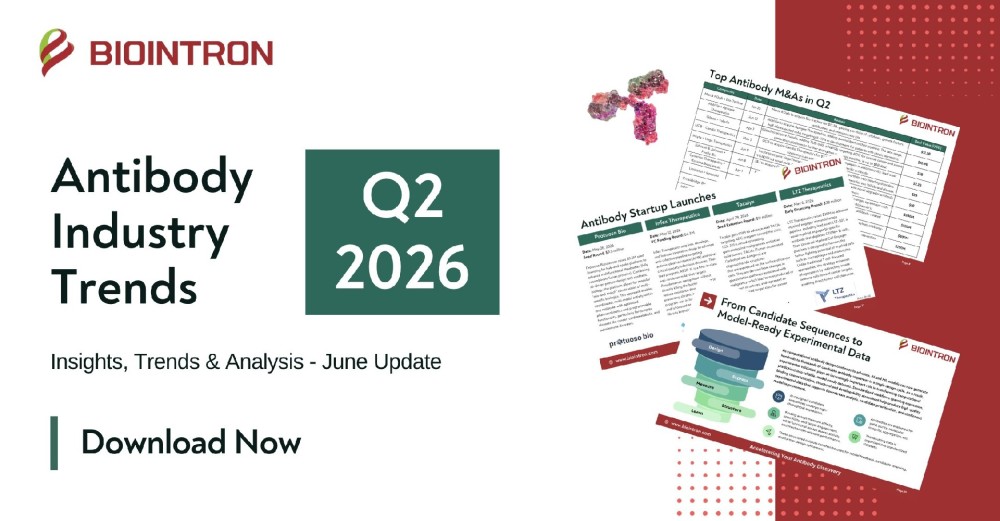
Biointron’s Q2 2026 Antibody Industry Trends report aims to explore the events a……
Biointron’s Q1 2026 Antibody Industry Trends report aims to explore the events a……
Biointron’s Q2 2025 antibody industry report aims to explore the events and tren……
Biointron’s Q1 2025 annual antibody report aims to explore the events and trends……