


Antibody drugs, particularly monoclonal antibodies (IgGs), have transformed modern medicine, especially in areas like cancer and autoimmune disease. Now, however, VHH antibodies, also known as nanobodies are increasingly being recognized for their potential in biopharmaceutical applications due to their unique properties such as specificity, small molecule size, high affinity, good stability, flexible delivery routes, and fast tissue penetration.
Derived from naturally occurring antibodies in camelids (such as llamas and alpacas), VHHs consist of a single binding domain instead of the two-chain structure of IgG antibodies. This design is roughly one-tenth the size of a traditional antibody, allowing them to penetrate tissues more easily, access hard-to-reach targets, and remain stable under conditions that would degrade other types of antibodies.

Typically, antibody discovery relies on screening large libraries of candidates, like searching for a “needle in a haystack.” For VHHs, this often involved immunizing animals or building large synthetic libraries and then selecting binders through iterative testing.
That model is changing as researchers are increasingly designing VHHs from the ground up, using computational tools and artificial intelligence (AI). For example, new synthetic libraries are built using human-like antibody sequences and carefully filtered to remove problematic features, allowing scientists to identify drug-like candidates much earlier in the process.
At the same time, AI tools such as structure prediction and protein design algorithms are accelerating optimization. These tools can:
Predict how a nanobody will bind to its target
Suggest mutations that improve stability or reduce aggregation
Optimize human compatibility to reduce immune reactions
VHH-specific AI models are also emerging. For example, nanoBERT uses a transformer-based architecture to predict biologically plausible amino acid substitutions within VHH sequences. By learning from nanobody-specific sequence context, rather than relying on broader antibody or protein models, it can support mutation design and thermostability optimization. AI-guided engineering can thus improve nanobody stability and production yields without compromising binding performance.
Similarly, the Therapeutic Nanobody Profiler (TNP) is a VHH-specific developability tool. Because nanobodies differ structurally from conventional antibodies, standard antibody profiling methods may not capture their unique liabilities. TNP uses clinical-stage nanobody sequences and experimental developability data to assess properties relevant to therapeutic development, helping researchers identify risks earlier and design more drug-like VHH candidates.
The flexibility of VHH antibodies is an advantage, as they can be linked together, like molecular building blocks. This has enabled the development of multispecific therapies, where a single drug can bind to multiple targets at once. For example, researchers are designing nanobodies that:
Target two different disease pathways simultaneously
Bind multiple sites on the same protein for stronger effects
Combine targeting with functions like extended half-life in the body
These “multi-epitope” or multispecific designs can improve both precision and effectiveness.

This modularity is especially evident in oncology, where VHHs are being used as therapeutic binders, delivery vehicles, imaging tools, and components of cell-based immunotherapies. As standalone domains, nanobodies can modulate tumor-associated signaling proteins, while engineered formats can guide cytotoxic drugs, radionuclides, immunotoxins, or imaging probes to tumor sites. They are also being integrated into CAR-T, CAR-NK, and CAR-macrophage platforms.
Advances in nanobody multimerization and multispecific engineering are helping to address some of the constraints of monomeric Nbs while opening functional possibilities that are difficult to achieve with conventional antibody formats. Using a range of in vivo and in vitro strategies such as flexible peptide linkers, antibody hinge domains, self-assembling coiled-coil systems, and chemical conjugation approaches, researchers have generated VHH-based constructs with improved apparent affinity through avidity effects, improved target specificity, and increased functional stability.

For a new drug class to succeed, it must also be manufacturable at scale. This is another area where VHHs are showing strong potential. Nanobodies can be efficiently manufactured in various systems such as Escherichia coli, Pichia pastoris, and mammalian cells. They have also been successfully expressed in plant systems such as tobacco plants and Arabidopsis thaliana.
The commercial momentum is already visible, as over the past decade, there has been a steady increase in:
Nanobody-related patents
Clinical trials
Approved therapies, such as caplacizumab for blood clotting disorders
At the same time, researchers are developing strategies to address limitations such as short circulation time in the body, including fusion to larger proteins or chemical modifications like PEGylation. In the near future, more diagnostic agents and therapeutic drugs based on VHH antibodies are expected to enter the market at lower prices, addressing some of the limitations associated with traditional antibodies.

As AI-driven design, modular engineering, and scalable manufacturing continue to advance, VHHs are well positioned to become a core platform for next-generation therapeutics. Despite the many candidates in clinical pipelines, the commercial translation of VHH-based therapeutics remains small. A primary obstacle involves identifying specific clinical indications where VHH antibodies demonstrate clear superiority over traditional monoclonal antibodies. Furthermore, their rapid renal clearance results in a short half-life. However, future advancements are expected to yield more cost-effective VHH antibody agents.
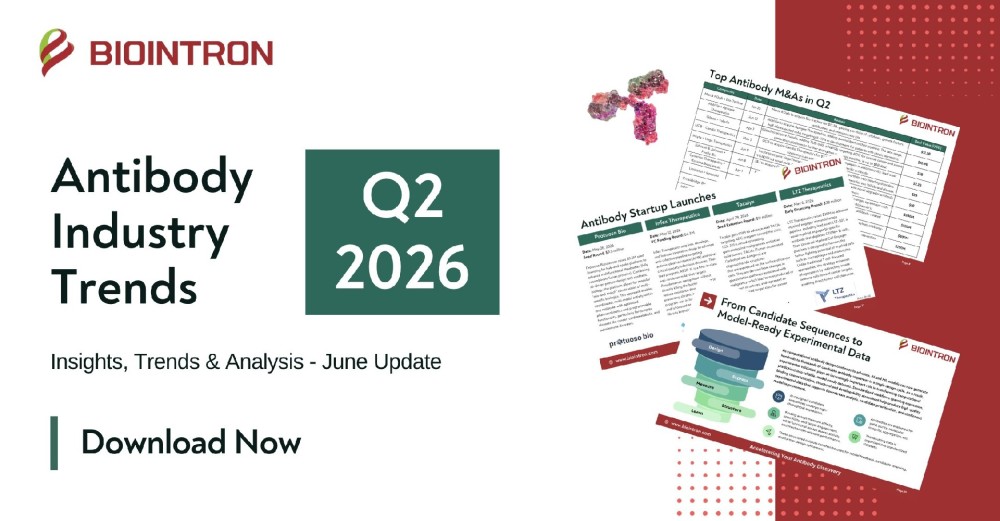
Biointron’s Q2 2026 Antibody Industry Trends report aims to explore the events a……
Biointron’s Q1 2026 Antibody Industry Trends report aims to explore the events a……
Biointron’s Q2 2025 antibody industry report aims to explore the events and tren……
Biointron’s Q1 2025 annual antibody report aims to explore the events and trends……